















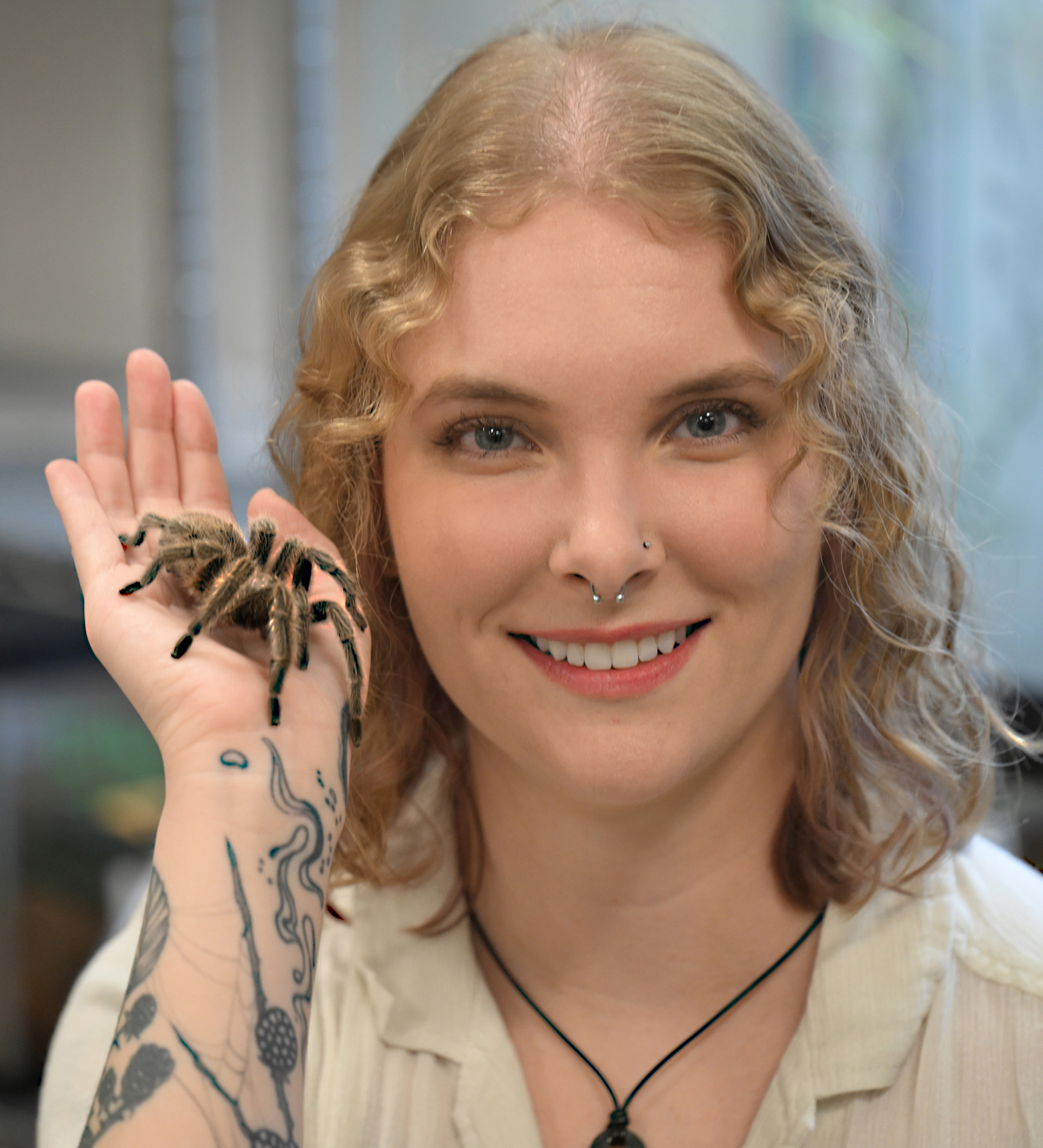
The Bohart Museum of Entomology will host an open house, themed “Eight-Legged Encounters” from 1 to 4 p.m., Sunday, March 15.

Chairing the event, which is free and family friendly, are doctoral candidate Emma “Em” Jochim of the Jason Bond lab and UC Davis alumnus Felix Duley, a Bohart Museum intern.
The open house will take place both in Room 1124 of the Academic Surge Building, 455 Crocker Lane, and in the hallway.
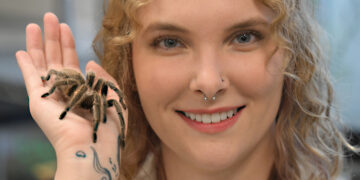
“We will have live arachnids–scorpions, tarantulas, a vinegaroon and a whip spider–and will do live feedings,” Jochim said. “The scorpion will be a desert hairy scorpion. We’ll have Peaches, a Chilean rose-hair tarantula, and we’ll have some native Aphonopelma species. We will also have preserved specimens and will be answering questions people have about arachnids.”
At the live petting zoo, to be set up in the hallway, visitors can hold Madagascar hissing cockroaches and stick insects, also known as walking sticks. Peaches, the rose-haired tarantula, is a fixture at the zoo, but is not available to be held by the public. The species is native to the grasslands of Chile, Argentina, Bolivia and Paraguay.
Also in the Academic Surge Building hallway, visitors will learn the different types of silk that spiders can make. Microscopes will be set up to see the specimens.
The family craft activity will involve “model magic clay so people can create their own arachnids to take home!” Jochim said.
Jochim is the lead author of internationally acclaimed research published last October in the journal Evolution and Ecology about a newly discovered species of trapdoor spider that inhabits coastal sand dunes stretching from Monterey to California Baja, Mexico. Jochim and colleagues analyzed genomic DNA from two trapdoor spiders thought to be the same species, Aptostichus simu, and discovered they are not.
Bond, director of the Bohart Museum and the Evert and Marion Schlinger Endowed Chair in Insect Systematics and executive associate dean, College of Agricultural and Environmental Sciences, named the new species Aptostichus ramirezae after arachnologist Martina Giselle Ramirez, dean of the College of Science at California State University, Stanislaus.
The research article, titled “Speciation Pattern and Process in the California Coastal Dune Endemic Trapdoor Spider Aptostichus simus (Mygalomorphae: Euctenizidae) and Description of a New Cryptic Species,” is the work of Bond, Jochim, research scientist James Starrett, and Hanna Briggs, a 2025 UC Davis entomology graduate.
Trapdoor spiders are so named because they construct their burrows with a corklike or wafer trap door made of soil, vegetation and silk. With the recent discovery, there are now four known species of trapdoor spiders in California that live in coastal dune habitats.
“My passion for studying spiders comes from how diverse and widespread they are,” Jochim said. “They are found on every continent except Antarctica and occupy almost every terrestrial niche! I think mygalomorphs are especially cool because of their larger sizes and long life spans–the oldest known trapdoor spider was 40 years old!”
Arachnophobia is a common phobia, but there are five good reasons to like spiders, says Bond, who serves as the president of the American Arachnological Association.
They are:
- Spiders consume 400-800 million tons of prey, mostly insects, each year. Humans consume somewhere around 400 million tons of meat and fish each year.
- Spider silk is one of the strongest naturally occurring materials. Spider silk is stronger than steel, stronger and more stretchy than Kevlar; a pencil thick strand of spider silk could be used to stop a Boeing 747 in flight.
- Some spiders are incredibly fast–able to run up to 70 body lengths per second (10X faster than Usain Bolt).
- Athough nearly all 47,000-plus spider species have venom used to kill their insect prey, very few actually have venom that is harmful to humans.
- Some spiders are really good parents –wolf spider moms carry their young on their backs until they are ready to strike out on their own; female trapdoor spiders keep their broods safe inside their burrows often longer than one year, and some female jumping spiders even nurse their spiderlings with a protein rich substance comparable to milk.
For more information on the open house, contact bmuseum@ucdavis.edu.